"KNOWLEDGE-BASED FITNESS"
Showing posts with label grip. Show all posts

Sunday, May 3, 2015

Train Smarter!

Train Smarter!

When trying to balance your training with work and family obligations, you may find yourself short on time.  But you figure, "something is better than nothing." So you need to train smart.  Knowing what you are training will help you to train efficiently.  So you should choose exercises wisely.  One example is the kettlebell lunge.
The 1 Arm Racked Kettlebell Lunge:

This exercise is obviously a leg exercise.  But that is not all!  You must hold the kettlebell in the racked position using one arm.  This places an asymmetric downward force on the kettlebell side of your trunk/body.  To prevent laterally "giving in" to the added weight, the opposite side of your trunk must contract to stabilize in order to maintain a neutral spine.  You must maintain grip on the kettlebell handle and not allow the shoulder blade on the side of the kettlebell to drop or protract due to the added weight either.  In all, you are training the legs, the trunk, grip and scapula stability.


Double Kettlebell Lunge:

Although you are lunging with added weight compared to the single kettlebell lunge, you do not have the asymmetric weight applied to the trunk.  So lateral stability will not be as much of an issue.  However, you must still maintain grip of each handle, prevent both scapula from protracting, and the added weight to your chest/trunk will actually make it slightly more difficult to deeply inhale during the set


To increase the challenge further, perform the Bottoms Up Kettlebell Lunge.  Here, you are working even harder to maintain control of the kettlebell handle using hand, wrist and forearm strength.  This also challenges scapula and shoulder stability on the kettlebell side, and the asymmetric weight will again require lateral trunk stability.  

So, if you want to get more bang for your buck, making slight adjustments to a traditional exercise will train more than you initially thought.  You end up training multiple regions of the body using one technique.  This is efficient training!

Sunday, April 13, 2014

Benefits Of The Single Leg Deadlift

Benefits Of The Single Leg Deadlift
 
When performing the Single Leg Deadlift, in order to maximize the benefits you must perform the technique with proper form, especially upon fatigue.  I have used this exercise to train ankle and knee stability, hip stability and strength, balance, trunk rotational stability, grip and scapula control (to name a few). 
To begin the technique, place the kettlebell on the inside of the stance leg so that as you flex forward you can reach the handle with the opposite side's arm

While lowering your trunk down towards the kettlebell, you do not want to allow your trunk to rotate.  Keep your shoulders and hips 'square' with the floor.  The image directly above is incorrect, while the image below is correct

You want to maintain a straight line from your shoulder to your hip, knee and ankle.  This will help you with the hip hinge technique which protects your lower back

Lower your trunk while maintaining scapula retraction.  Keep your ears in line with your shoulders.  You lower your trunk until your hand reaches the kettlebell handle. 

 
Do Not allow your scapulae to protract or your trunk to rotate towards the kettlebell in order to "lengthen your arm" for you to more easily reach the handle.  You will need to work hard at this especially upon fatigue


Grip the handle, contract your glutes and scap retractors and return to stance
 
Finish the repetition in tall standing with glutes squeezed. Do not rush into the next repetition by not locking out in tall standing first

Thursday, March 27, 2014

Drive Through Your Hips

Drive Through Your Hips
 
Throwing a ball, swinging a club or a tennis racket and even punching an opponent revolve around rotational force of the hips as well as forces produced through the ground, rather than solely upper extremity strength.  The order of recruitment of power, particularly with heavy hitters is as follows: the swing is led first by the hips, then the trunk, arms, hands and finally the bat.  The more rotational velocity you can produce with your hips, the greater the force transmitted to the ball.  To improve this hip velocity and ground force, you should practice the movement pattern as well as practice the actual task (specificity of training).  If we learn how to create more force through the ground, this increased force will transmit through our bodies and into our target.  Check out the hip position and trailing foot in these pictures:


If we practice a technique that focuses on hip rotational velocity and explosiveness, we will throw further/faster, hit harder, punch with more force, etc...Here are some simple exercises that will help "groove" the hip rotation motor pattern:  Notice the trailing leg, how the foot pivots, the hip extends, and the 'snap' of the hip rotation/extension.  This creates the force that transmits through the trunk, into the upper extremities, directed toward the goal.  If you do not pivot on your trailing foot, you risk injuring your knee.
 
 
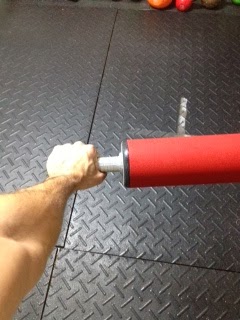
Here, I use a Persian Mil to help train the pivot, hip rotation, and trunk stability, as I thrust the Mil forward. This works the above discussed movement pattern as well as grip strength and shoulder stability.  To challenge the grip even more, I perform this technique using Neurogrips


 Now, I perform the same activity using a longer lever which makes control and stability even more difficult.  This further develops rotational hip velocity, trunk control and coordination of my lower extremities.
 
 
 You can try this out with a wooden dowel to smooth out the movement pattern, and progress to a weighted bar.


Wednesday, March 12, 2014

More on Forearm and Wrist Strength: Pronation and Supination

More on Forearm and Wrist Strength:
Pronation and Supination
 
 
In previous posts I spoke about forearm, wrist and hand grip strengthening in the direction of elbow flexion (Bottoms Up Bicep Curl), wrist flexion and extension, and wrist radial and ulnar deviation both dynamically and statically with the focus on maintaining wrist stability while a resistance is applied at a certain direction.  Today I will discuss training forearm pronation and supination. 
 This photo is of my hand, wrist and forearm in the neutral position holding a dumbbell
 This photo is of my hand moving into the pronated position

 This is a photo of my hand in the supinated position
 
Moving from neutral to pronation and back to neutral holding the weight in this manner is training the supinators
 
        
Moving the weight from neutral to the supinated position and back to neutral is training the pronators 

 To make the above exercises more challenging, just increase the length of the lever you are trying to move (Here I use a Persian Mil) - Neutral Position

Pronated Position
 
 
Supinated Position
 
To add even more of a challenge, add thickness to the handle using Neurogrips.  This will challenge your grip as well as your forearm strength

Neutral Position Using Neurogrips


Pronated Position Using Neurogrips
 
Supinated Position Using Neurogrips

 And now to challenge your grip and forearm muscle endurance... Maintain a static position of your hand, wrist and forearm while a pronation or supination force is applied:
 Here, the Persian Mil apply a force in the direction of forearm supination and in order to prevent any motion, the pronators must contract isometrically while I perform kneeling rear delt lifts

Here, the Persian Mil apply a force in the direction of forearm pronation and in order to prevent any motion, the supinators must contract isometrically while I perform kneeling rear delt lifts
 
Try the above progressions to further improve your grip strength


Thursday, January 30, 2014

The Single Leg Deadlift Using Neurogrips and The Nabard Device

The Single Leg Deadlift Using Neurogrips and The Nabard Device: Ulnar Deviation Bias
 
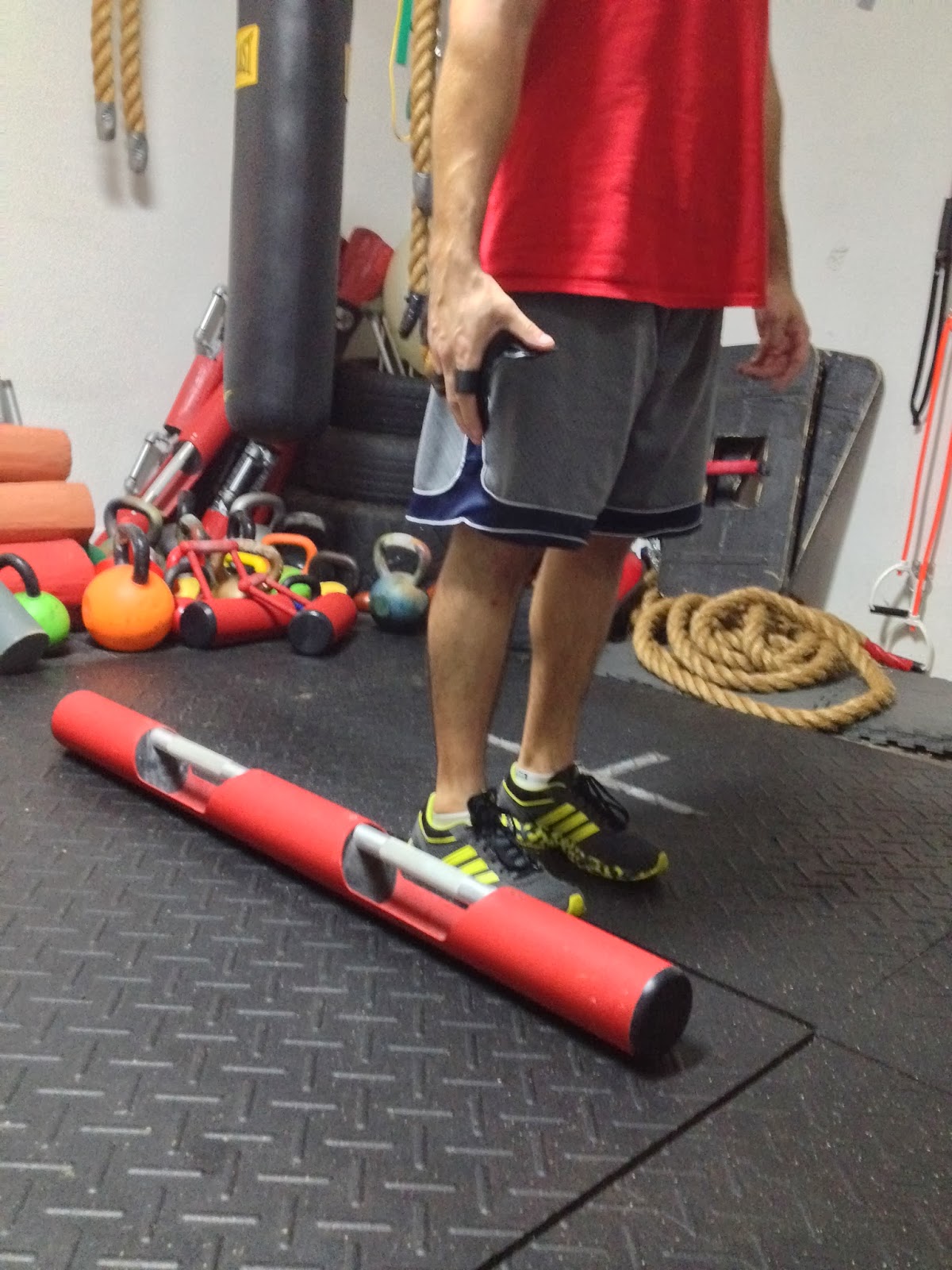
The Nabard Long Device used in this example is a device similar to a barbell.  However, the 1 inch diameter handle is offset rather than centralized.   The Neurogrips easily slide on your hand, adding 1" diameter to the Nabard Device handle, making it about 2" in diameter.  Combined with the offset handle, the Neurogrips challenge your grip and help strengthen your hand, wrist, forearm as well as your shoulder and trunk musculature.   

Place Neurogrips on the right hand.  Stand next to the Long Device (Device is closest to your right foot) so that the longer end extends behind you

Kick your right leg straight behind you, allowing your left knee to slightly bend so that your right hand can reach the handle of the Long Device.  Do not let your hips move out of the parallel position in relation to the floor (Do not let either hip rise or fall).  Contract your right gluteals to maintain full right hip extension.  Squeeze the Neurogrips around the device handle tightly.  Maintain Scapula Retraction (Do not let your shoulder blade protract toward the device to assist your reach - Maintain Scapula Stability)

Squeeze your glutes, press your left foot into the ground and stand up tall, locking your glutes at the top.  Do not allow the long end (which is now behind you) of the Nabard device to dip down.  With this, the long end is placing downward force on your hand and wrist, in the direction of radial deviation.  To maintain neutral wrist position, you must fire your ulnar deviators as well as maintain a crushing grip on the handle due to the increased diameter from the Neurogrips.  This will work your hand, wrist, forearm, elbow, shoulder and trunk musculature.  To see how much of a challenge Neurogrips provide, try one set with and the next set without the Neurogrips on.

Sunday, January 26, 2014

The Single Leg Deadlift Using Neurogrips and The Nabard Long Device

The Single Leg Deadlift Using Neurogrips and The Nabard Long Device: Radial Deviation
 
 
The Nabard Long Device used in this example is a device similar to a barbell.  However, the 1 inch diameter handle is offset rather than centralized.   The Neurogrips easily slide on your hand, adding 1" diameter to the Nabard Device handle, making it about 2" in diameter.  Combined with the offset handle, the Neurogrips challenge your grip and help strengthen your hand, wrist, forearm as well as your shoulder and trunk musculature.   
 
 
Place Neurogrips on the right hand.  Stand next to the Long Device (Device is closest to your right foot) so that the longer end extends in front of you

Kick your right leg straight behind you, allowing your left knee to slightly bend so that your right hand can reach the handle of the Long Device.  Do not let your hips move out of the parallel position in relation to the floor (Do not let either hip rise or fall).  Contract your right gluteals to maintain full right hip extension.  Squeeze the Neurogrips around the device handle tightly.

Squeeze your glutes, press your left foot into the ground and stand up tall, locking your glutes at the top.  Do not allow the long end of the Nabard device to dip down.  With this, the long end is placing downward force on your hand and wrist, in the direction of ulnar deviation.  To maintain neutral wrist position, you must fire your radial deviators as well as maintain a crushing grip on the handle due to the increased diameter from the Neurogrips.  This will work your hand, wrist, forearm, elbow, shoulder and trunk musculature.