
 Posts
Posts


More on Forearm and Wrist Strength:
Pronation and Supination
In previous posts I spoke about forearm, wrist and hand grip strengthening in the direction of elbow flexion (Bottoms Up Bicep Curl), wrist flexion and extension, and wrist radial and ulnar deviation both dynamically and statically with the focus on maintaining wrist stability while a resistance is applied at a certain direction. Today I will discuss training forearm pronation and supination.

This photo is of my hand, wrist and forearm in the neutral position holding a dumbbell

This photo is of my hand moving into the pronated position

This is a photo of my hand in the supinated position
Moving from neutral to pronation and back to neutral holding the weight in this manner is training the supinators
Moving the weight from neutral to the supinated position and back to neutral is training the pronators
 To make the above exercises more challenging, just increase the length of the lever you are trying to move (Here I use a Persian Mil) - Neutral Position
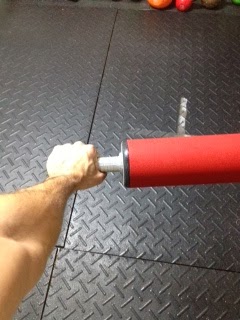

Supinated Position
To add even more of a challenge, add thickness to the handle using Neurogrips. This will challenge your grip as well as your forearm strength


Pronated Position Using Neurogrips

Supinated Position Using Neurogrips
And now to challenge your grip and forearm muscle endurance... Maintain a static position of your hand, wrist and forearm while a pronation or supination force is applied:
 Here, the Persian Mil apply a force in the direction of forearm supination and in order to prevent any motion, the pronators must contract isometrically while I perform kneeling rear delt lifts

Pronated Position
Supinated Position
To add even more of a challenge, add thickness to the handle using Neurogrips. This will challenge your grip as well as your forearm strength
Neutral Position Using Neurogrips
Pronated Position Using Neurogrips
Supinated Position Using Neurogrips
And now to challenge your grip and forearm muscle endurance... Maintain a static position of your hand, wrist and forearm while a pronation or supination force is applied:
Here, the Persian Mil apply a force in the direction of forearm pronation and in order to prevent any motion, the supinators must contract isometrically while I perform kneeling rear delt lifts
Try the above progressions to further improve your grip strength


