"KNOWLEDGE-BASED FITNESS"
Showing posts with label lower back pain. Show all posts

Monday, July 20, 2015

"If You Keep Picking At It, It Will Never Heal"

"If You Keep Picking At It, It Will Never Heal"


Recovering from a lower back injury is similar to any other injury.  If you fall and cut your knee, the healing process will be postponed if you constantly pick at the scab.  When you are rehabilitating from lower back pain, the more frequently you irritate the injury, the longer it will take to heal.  This means that you must protect your spine during everyday routine activities.  

Stu McGill describes your lower back as a savings account, advising you not to "spend" it frivolously.  If you continue to unnecessarily involve/mobilize the spine in activities that do not require its involvement/mobility, then when you do "need" the spine, it will not be there for you at 100%.  

One example of this is...click here for full article

Thursday, July 24, 2014

Minimizing Strain On Your Lower Back

Minimizing Strain On Your Lower Back


When performing any type of exercise in the prone position (lying on your stomach), whether for fitness or rehabilitation, in order to minimize the strain on your lower back, consider placing 1 to 2 pillows under your pelvis. 
 
Observe that just by being in the prone position, the lumbar spine is already in an extended position.  Lifting your arm or leg will create hyperextension in the lower back , which may be uncomfortable particularly for anyone recovering from lower back injury/surgery
 
At rest, with a pillow under the pelvis, you can see that the lower back is in a neutral position
 
Upon lifting an arm or leg now, lumbar hyperextension is avoided and the lower back is spared.


Tuesday, April 22, 2014

Leg Press and Lower Back Rehab

Leg Press and Lower Back Rehab


When working with patients recovering from lower back injuries, particularly bulging or herniated discs, I mentioned in previous posts that my goal is to improve function while minimizing irritation to the lower back.  For people rehabilitating from bulging or herniated discs, I avoid spinal flexion activities, as this may cause further disc protrusion.  I do not usually use the leg press machine, as in my opinion there are more functional lower extremity activities that I would rather spend time performing.  However, if for whatever reason you are using the leg press with your "lower back client," you can minimize the strain placed on the lower back by performing single leg presses rather than bilateral presses.  Here, the non-working leg remains on the floor during the press. 
Image 1
Image 2


In image 1, you can see that at the deepest part of the motion, where the knees are up against the chest, the lower back is extremely flexed.  This may lead to further posterior "disc creep."  In image 2, keeping the non-working leg on the floor helps to maintain a more neutral pelvis and lumbar spine, decreasing disc protrusion.  This places much less stress on the spine and intervertebral discs.


Sunday, March 23, 2014

Posture and Spinal Compression

Posture and Spinal Compression


Posture is one of the very first things I assess when working with a client, especially one who presents with lower back pain.  A majority of the clients who I treat for lower back pain require postural reeducation due to maintaining a slumped or flexed posture. 
 
Keeping this posture throughout the day results in tight anterior muscles, such as the pectoralis, and stretched out, weakened scapula retractor muscles (middle traps).  When we analyse this posture, we can see that the head is anterior, the shoulders are anterior and protracted and the lumbar spine is flexed.  This places an anterior weight distribution to our upper body.  What stops us from continuing to flex forward and eventually falling on our face?
 
The answer is our spinal extensors which run longitudinally up and down our spine.
These long extensors contract in order to limit any more flexion, thereby stopping us from completely flexing forward.  However, the constant engagement of these muscles actually compresses the vertebrae, creating more lower back pain!  You can feel these hardened muscles by palpating the lower back of your clients.  If the muscles on either side of the vertebral spinous process feels "hard as a rock," then you can assume these muscles are "on" all day, and this is part of the reason for their lower back pain.  Keep your hand on these muscles and ask your client to contract their glutes ("clench"), retract their shoulders and tuck their chin.  Now see if these muscles "soften" to your touch.  By relaxing these muscles, you are reducing the amount of spinal compression and eventually the pain will diminish. 
Now certain activities require you to flex forward, such as shaving.  Many of my clients complain of increased lower back pain when shaving or doing the dishes.

  With this, I spend time educating them in performing a hip hinge and a lunge position rather then flexing forward from the spine.  This usually helps immediately.  Others will ask me if they should purchase a posture brace.  I am not a big supporter of these braces, as they do the work for you.  You rely on an external support device to maintain your posture rather than your own muscles.  Therefore, the muscles that need to be strengthened and those that need to be stretched are not really getting what they need, and the person wearing the brace never develops the body awareness to maintain proper posture.  Although not much substantial evidence exists regarding kinesiotape, I find that it does provide the proprioceptive input that "tells" you to maintain the neutral spinal posture rather than the slumped position.  In my experience, upon applying kinesiotape, these lumbar muscles relax and the pain diminishes.

 So first, assess your client's posture.  Second, palpate the longitudinal spinal extensor muscles on either side of the vertebrae.  Third, have your client squeeze their glutes, retract their shoulders and perform a chin tuck.  Assess what the muscles feel like now.  Teaching your client to maintain this posture will be one of your client's main goals during everyday life as well as during resistance training.  For more information on posture and body mechanics, check out the DVD at: www.lowbackpainvideos.com


Saturday, December 21, 2013

Lower Back Pain and Radiating Symptoms

If you have been suffering with Lower Back Pain and radiating symptoms into your legs, you may want to know why this is happening and what you can do for relief. 

This video may help: Lower Back Pain Radiating Symptom Management

Thursday, December 19, 2013

Incorporating The Bridge

Incorporating The Bridge

 
The bridge is a common exercise prescribed to clients suffering from lower back pain.  Many of these  patients commonly present with crossed-pelvic syndrome (weak glutes and abs, tight hamstrings and hip flexors).  They have overworked hamstrings and underworked gluteals.  Upon performing the bridge, most will initiate the extension movement by firing their hamstrings, instead of their glutes.  Our goal is to teach them how to engage their gluteals first.  This will carryover into functional activities such as squatting.  Start by teaching a "Glute Set."  To do this, you have your client lie on their back and clench their butt.  The cue "pinch a dime" works well.  Then perform this same technique with your client lying on his/her back with their knees bent and feet flat on the floor.  "Pinch a dime" again.  Repeat this without any actual lifting of the pelvis until it is performed without hamstring contraction.  Palpate their hamstrings to ensure this.  Then, have them perform this technique and lift the hips off the floor.  If the hamstring are still firing early, having your client attempt the bridge with their toes touching a wall may help.  In this position, upon attempting the lift, gently ask your client to push their toes into the wall as if trying to extend the knees.  Contracting the quadriceps here, will inhibit the hamstrings from firing, and the glutes will do the work.  Have your client repeat this until it becomes habit.  Then check out the quality of their squat and see if it has improved.    

Monday, December 2, 2013

Body Awareness

Body Awareness
 
Most people who are suffering from low back, knee, neck or other common conditions can greatly reduce their symptoms by simply correcting their posture, body mechanics, lifting techniques, etc..  However, this is not so simple.  Many people do not have the body awareness needed to perform correction techniques merely upon verbal cues by their trainer or therapist.  When I am faced with this client, I will allow them to rely on a mirror for feedback as well as providing them with manual cues.  Nowadays, everyone has a cell phone with camera capabilities.  I have taken pictures during a session and either emailed 'before' and 'after' photos to my clients for further education or I print out the photos to use during their sessions for visual feedback.  After educating my clients using these tools (mirror, photos, manual cues), I assess the carryover by removing those tools.  Once they are able to correctly perform the task at hand, I remove the external cues so that they further develop body awareness.  My goal is to ensure independence with body awareness.  After all, your client will not always have a camera, a trainer/therapist or a mirror available when performing daily activities.     

Saturday, November 30, 2013

Have Your Client Keep A Diary

Have Your Client Keep A Diary
 
Many times, clients you are training for their lower back pain seem to take one step forward and two steps back, or may make very slow progress combined with many setbacks.  Upon asking them "what happened," they say that they "have no idea."  You should not stop with that, though.  Most of the time, clients don't realize that even the slightest change in activity level or any additional activity performed may be the cause of their setback.  You should not be satisfied with their answer.  You need to probe further.  Have them walk you through their day, asking them throughout if what they are describing is their normal routine or not.  In this situation, I usually recommend my client keep a daily diary of activities and responses.  I tell them to write down what they do and how they feel afterwards.  If they feel lower back pain, they should stop and think about what activities preceded it.  However, explain to them that it is very important not to anticipate the pain.  They should not be so fearful that pain will result from an activity that they become 'bed-bound.'  You will want them to maintain as much of their regular routine as possible.  The diary will help you, as their educator, to alter the mechanics of the activities in order for them to be performed pain-free.  Sometimes, the slightest change in body mechanics, posture, body position or lifting technique will completely eliminate their pain.  The diary will give you a baseline focus for your sessions.  It will help you to not only make continuous assessments, but will also allow you to provide the appropriate corrective exercises.        

Tuesday, November 26, 2013

"No Pain, No Gain, Right???"

"No Pain, No Gain, Right???"


Wrong!!! Here's a quick tip when working with a back injury.  It is advised that therapeutic exercise for a lower back condition be pain-free.  If not, pain during the activity will create 'substitution' movement patterns as the spine attempts to protect itself from feeling the pain.  These 'substitution' movement patterns will cause more problems later on.  Your initial goal here is to relieve the inflamed tissues first, then work on regaining functional movement.   

Friday, November 22, 2013

Back Belt 2

More on Wearing Back Belts
 
 
The Valsalva Technique is a maneuver that people perform when they hold their breath and exert/squeeze/bear down.  Upon study, this technique creates an increase in Intra-Abdominal Pressure (IAP), which causes an increase in lumbar compression.  The prior theories stated that wearing a back belt would increase intra-abdominal pressure which would decrease compressive load.  However, this theory has been proven false.  As stated before, an increase in (IAP) pressure will increase lumbar compressive load.
 
The other theory was that the back belt will provide support to the lumbar extensor muscles.  The muscle activity of the extensors and the abdominals has been measured while a back belt was worn, and no significant change in muscle activity was shown. 
 
Also, when lifting and wearing a back belt, it was noted that blood pressure and heart rate rose significantly when compared to those lifting without a back belt.  With this, you would hope for a cardiovascular screening prior to any employer handing an employee a back belt to wear.  
 
Take home message:  The benefits of wearing the back belt are not as apparent as we once thought.  If a business requires its employees to wear these belts, their focus should be placed more on educating employees on overall fitness, body mechanics, lifting techniques and ergonomics so that they can rely on themselves for injury prevention rather than the back belt.  Interestingly, it was found that when wearing a back belt, the amount of weight a person was willing to lift rose 19%.  Does the back belt provide a false sense of security?  Either way, if you are used to wearing one, it is not advisable to eliminate it completely, but to wean yourself from it.     

Wednesday, November 6, 2013

Worker's Compensation Light Duty

Worker's Compensation Light Duty
 
I have been treating a patient referred to me by Worker's Compensation.  This patient had a diagnosis of lower back pain.  His job consists of sitting at a desk for 8 hours straight with only two 15 minute breaks to get up to use the bathroom and an hour lunch.  Many propose that the time spent in sitting should be limited to 50 minutes before a short 'standing' break is taken.  
This patient states only the timed breaks described are allowed by the supervisor.  Therefore, I suggested that during this break, the employee perform the opposite movement/activity that they were performing while working.  Since sitting imposes flexion on the spine, which stresses the intervertebral disc's annulus fibrosis and may lead to disc posterior "creep," it is suggested that you stand up tall, raise the arms overhead, and push the hands toward the ceiling with a deep inhale.  This will fully extend the lower back, which reduces the annulus stresses.  I recommended that this patient stand as often as possible throughout the work day to go through the necessary work related paperwork.  Instead of sitting in a chair, bending forward to go through a bin of papers, place the bin on a higher surface and stand to do the same activity.  This will allow you to continue doing your job (so your supervisor can't complain), while at the same time 'sparing' your spine.  Your goal is to continually change positions so that the strain on your spine is not focused solely on one location, but shifts. It seems that patients who come to me with lower back pain are those who remain in the same position for extended periods of time.  If they were able to change positions frequently during their shift, their spine would be 'healthier.'  Unfortunately, once these patients are injured, they are usually placed on light duty, which consists of sitting in one position for even longer times during the work day, with minimal physical activity.   

Monday, November 4, 2013

Twisting Activities And Your Lower Back

Twisting Activities And Your Lower Back


Activities that require twisting your trunk while simultaneously increasing torque  (building axial torque) may lead to lower back trouble! 


Twisting motion disables the support fibers of the intervertebral disc's annulus fibrosis, which may lead to a bulging or herniated disc. 


Since it is believed that there are no muscles designed to produce only torso rotation (axial torque), then there is a limitation to muscles resisting rotational torque. Therefore, your goal is to generate rotational torque, while restricting torso twist.
Limits Torso Rotation


Friday, November 1, 2013

Vacuuming and Lower Back Pain

Vacuuming and Lower Back Pain
 
Many times, a patient with a diagnosis of lower back pain will tell me that the pain seems to increase when vacuuming. 
Most people tend to push/pull the vacuum with one arm.  The vacuum is held to one side, which places a twisting torque on the lower back.  This force causes man increase in lower back pain.
 
 In this picture, the man is holding the vacuum with two hands directly in front of his belly button.  The force is directed through the lower back with no rotational torque and is therefore less aggravating to the lower back.  Because of this, I usually advise my patients to try their best to keep the handle of the vacuum directly in front of their belly button region, at least until the acute symptoms subside.  As this new technique may not be familiar, it will protect the spine.  The more spine-sparing techniques that you perform during the day, the more you minimize the chances of symptom return. 

Wednesday, October 30, 2013

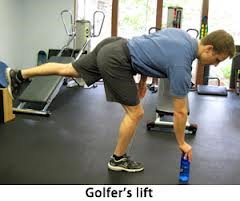
Golfer's Lift

Golfer's Lift
 
The golfer's lift is a helpful technique that you can use to lift lighter objects from the floor while sparing your spine. 
 
 
You can see there is a slight bend on the support leg knee, the lower back remains flat (not flexed), as a hip hinge technique is utilized rather than flexion of the spine.  There is also minimal rotation of the spine.  More helpful techniques are explained in the S.O.D. Posture & Body Mechanics DVD - Posture & Body Mechanics DVD

Saturday, September 28, 2013

What is the Crossed-Pelvis Syndrome?

What is the Crossed-Pelvis Syndrome?
 
 
The term "Crossed-Pelvis Syndrome" was used by Dr. Vladamir Janda to describe common characteristics of people suffering from chronic low back issues.  The pattern describes weak gluteals (posteriorly) and abdominals (anteriorly) and tight hip flexors (anteriorly) as well as tight lumbar extensors (posteriorly). 
 
There is also an Upper Crossed Syndrome, which presents as tight upper trapezius muscles (posteriorly) and tight pectorals (anteriorly), with weak deep neck flexors (anteriorly) and weak lower traps (posteriorly)
 If you have a client with chronic lower or upper back issues, you may want to assess the muscles mentioned above in your evaluation to see if they fit these Crossed Syndrome categories.
 

Thursday, September 19, 2013

Bending Forward or Bending Backward?

Bending Forward or Bending Backward?
 

Throughout Physical Therapy School, we were taught that a intervertebral disc consists of an outer layer, the annulus, with an inner region, the nucleus.  Upon bending backwards (extension), the nucleus shifts anterior (toward the front of your body), while during flexion or bending forward, the nucleus travels posteriorly (toward your back).  Most patients experiencing a bulging or herniated disc show a migration of the nucleus posteriorly, placing pressure on the posterior annulus. 
I have prescribed the Passive Cobra Stretch to many patients experiencing a bulging or herniated disc.  This passive extension exercise creates anterior shifting to the nucleus, decreasing pressure on the posterior annulus. 
Many times, the nucleus migrates posteriorly due to repeated or sustained spinal flexion.  This causes compression on the disc and if lifting is introduced at this time, even more stress is placed on the posterior aspect of the annulus.  It is recommended to avoid lifting if you have been sitting or stooping for an extended time.  You should instead stand tall and extend your spine to allow the ligaments to become stiff again (they were stretched when the spine was flexed) in order to protect your back. 
 
Drivers and athletes should pay particular attention to this.  Athletes should avoid sitting on the bench for an extended time when waiting to play. 


Drivers should use a Lumbar Support pad on their seat to maintain their lordotic curve.  This curve maintains the anterior position of the nucleus within the annulus.


Tuesday, September 17, 2013

Walking And Your Lower Back

Walking And Your lower Back
 
 
Here's a quick tip that may help you if you are experiencing lower back pain when walking.  First of all, when you are walking, the compression placed on your lumbar spine is equivalent to 2.5 times your body weight (ouch!).  To reduce the compressive loading, muscle activity and torque placed on the lumbar spine, you should attempt to walk at a slightly faster pace while swinging your arms (at your shoulders not your elbows).  Faster walking may assist in "sharing" the compressive load, while walking slowly increases the static load on your spine and may be more painful.  It is hypothesized that swinging of the arms helps the body use elastic energy to move the body rather than just muscle contractions which are compressive to the spine.  So if you are experiencing lower back pain when walking, take notice of the speed of your gait.  Try to increase the speed while continuing to walk with a reciprocating pattern (right arm moves forward as left leg moves forward).  See how your back responds. 

Thursday, September 12, 2013

Training Spinal Extensors on Clients With Lower Back Conditions

Training Spinal Extensor Muscles on Clients With Lower Back Conditions


When training a client who is rehabilitating from a lower back condition, besides strengthening the abdominal and core muscles, you will also want to focus on the posterior spinal muscles, the extensors.  Which of these exercises have you used with this goal in mind?
Exercise 1

 
Exercise 2

 
Exercise 3


It is recommended when training these muscles to treat them as 4 separate groups, two thoracic sections (right/left) and two lumbar sections (right/left).  Training one section at a time will minimize the amount of spinal load/compression.  Exercise 2 places the most compression load on the spine, while Exercise 1 places the least spinal compression load.    This is because Exercise 1 is activating one lumbar and one thoracic section, while the other two exercises are activating all 4 sections during each contraction.  Keep this in mind when working with clients with lower back conditions and try your best to minimize spinal compression loads during your sessions.

Friday, March 5, 2010

Fitness Post Partum

As a Physical Therapist, I have treated many new moms who are suffering from lower back pain.  During the initial evaluation interview process, most moms say their back hurts whenever they bend over the crib rail to lift their infant or when they attempt to lift their toddler from the floor.  They have difficulty carrying their child especially when they are required to multi-task, a responsibility all moms are familiar with.  After assessing their movement patterns, I usually start by correcting their body mechanics.  Once the pain level is reduced, we begin a strengthening program to prevent this pain from returning.  CLick on the link below to see a few of the exercises.

http://www.youtube.com/watch?v=Wj5--8ZS-vo