"KNOWLEDGE-BASED FITNESS"
Showing posts with label rotator cuff. Show all posts

Tuesday, July 9, 2013

What is the difference between the Rotary Cup and the Rotor Cuff?

What is the difference between the
Rotary Cup and the Rotor Cuff?
 
 
Nothing! But when someone uses either term, they really mean to say Rotator Cuff.  Four muscle make up the rotator cuff.  An easy way to remember which muscles comprise the rotator cuff is S.I.T.S. which stands for:
Supraspinatus
Infraspinatus
Teres Minor
Subscapularis
The Supraspinatus acts to Abduct the arm or lift it to the side.
The Infraspinatus externally rotates the arm
Teres Minor also externally rotates the arm
Subscapularis internally rotates the arm
Abduction

Internal rotation

External rotation
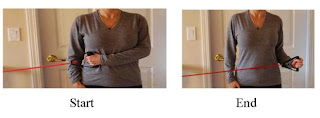
 
Many times, you will see someone using a resistance band with the elbow bent at their side, rotating the arm out and in against resistance of the band.  When you ask them what they are training, they will say their "Rotary Cup."  That is only part of the necessary training for the rotator cuff.  These muscles are actually stabilizers of the shoulder.  Their primary action is to stabilize, not to internally or externally rotate, or abduct the arm (secondary action).  So, it is okay to initiate training with the standard resistance band internal and external rotation exercises.  However, the more advanced rotator cuff training comes when you focus on stabilization of the shoulder. Click here to see some shoulder/scapula stabilization techniques.  http://www.strengthondemand.com/Body_Mechanics.html

Thursday, April 14, 2011

Develop Shoulder Proprioception Part 2: Prerequisite to Kettlebells

Progressing your client from basic exercises to more challenging techniques should be a somewhat cautious task, especially with training devices that they are less accustomed to.  For example, when performing a Kettlebell Windmill or Overhead Squat, if your client does not "pack" his shoulder and maintain its stability, he may lose control of the Bell, causing injury to himself or others training in the same area.  Watch this video and try for yourself.  It is a great low risk exercise that trains your shoulder stability in 360 degrees.  You can easily adjust the resistance, and if you lose the shoulder "packed" position, there is less risk of injury.  Get your client used to this stability activity before handing him/her a Kettlebell.
http://www.youtube.com/watch?v=7c-ivj0prK0

Wednesday, April 6, 2011

Develop Shoulder Proprioception - Part 1

Proprioception is defined as the "the sense of the relative position of neighboring parts of the body."  It tells us where the various body parts are located relative to eachother.  In Physical Therapy, Proprioceptive Training is extremely important to assist a patient's recovery from joint injuries (such as rotator cuff tears or surgerical repair) as well as preventing future injuries.  If you have little control of your joints or extremities (aka poor body awareness), it is only a matter of time before you get hurt. 


When training with irregularly shaped devices such as the Kettlebell or Persian Mil, body awareness is particularly important, as these devices are more difficult to control than conventional dumbbells or barbells.  Prior to training a beginner with Kettlebells or Clubs, I would advise the basic prerequisite exercises shown in this video.  They can be used as a warm up or part of your program to maximize joint stability.

http://www.youtube.com/watch?v=hp8iOAj1Pas

Normal progression of the "tracing" exercise is:
1)Supine (lay on back) and trace small size letters/shapes with your eyes open
2)Supine and trace large letters/shapes with your eyes open
3)Seated with arm overhead, trace small and then large size letters/shapes with eyes open
4)Repeat the above order with eyes closed
Have someone give you feedback on the your ability to maintain control with your eyes open versus eyes closed
5)Progress to using the kettlebell or Mil