"KNOWLEDGE-BASED FITNESS"
Showing posts with label kb fitness. Show all posts

Tuesday, July 9, 2013

What is the difference between the Rotary Cup and the Rotor Cuff?

What is the difference between the
Rotary Cup and the Rotor Cuff?
 
 
Nothing! But when someone uses either term, they really mean to say Rotator Cuff.  Four muscle make up the rotator cuff.  An easy way to remember which muscles comprise the rotator cuff is S.I.T.S. which stands for:
Supraspinatus
Infraspinatus
Teres Minor
Subscapularis
The Supraspinatus acts to Abduct the arm or lift it to the side.
The Infraspinatus externally rotates the arm
Teres Minor also externally rotates the arm
Subscapularis internally rotates the arm
Abduction

Internal rotation

External rotation
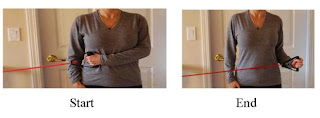
 
Many times, you will see someone using a resistance band with the elbow bent at their side, rotating the arm out and in against resistance of the band.  When you ask them what they are training, they will say their "Rotary Cup."  That is only part of the necessary training for the rotator cuff.  These muscles are actually stabilizers of the shoulder.  Their primary action is to stabilize, not to internally or externally rotate, or abduct the arm (secondary action).  So, it is okay to initiate training with the standard resistance band internal and external rotation exercises.  However, the more advanced rotator cuff training comes when you focus on stabilization of the shoulder. Click here to see some shoulder/scapula stabilization techniques.  http://www.strengthondemand.com/Body_Mechanics.html

Sunday, May 9, 2010

LOG TRAINING: New to the Fitness Industry

Recently, I had the privilege to learn the new training technique created by Master Safakhoo of Nabard Fitness Systems.  This training tool, called Log Training, has many advantages and benefits.  It can be used  not only by fitness enthusiasts, but also for athletes, especially martial artists, MMA, tennis and golf players. As a Physical Therapist and Personal Trainer, I see this new fitness tool to be one of the most diverse in the industry.  Check out the link below and http://www.strengthondemand.com/ for more info.

  http://www.youtube.com/watch?v=tCo30lBPIHU

Sunday, February 28, 2010

Protect Your Lower Back By Engaging Your Core

Check out this quick video on how to engage your core during exercise.  Learn to use a feedback technique (your own hands) to make sure your core is contracted properly.  Now, it is your job to make sure you maintain this contraction throughout the entire workout.  No need to focus so much on timing your breathing during the positive/negative portion of the contraction (I'm sure you have all heard "exhale upon exertion") for spinal stability when you use this technique.  Mastering this skill will greatly reduce your chances of injuring your lower back.

http://www.youtube.com/watch?v=gGT8ckhUrE8

Monday, February 22, 2010

Knee Pain: What Can You Do For It?

Many people, especially athletes have complained of knee pain one time or another, especially during activities such as squats and stairclimbing.  Instead of focusing in strictly on the knee joint, neighboring joints/muscles should be assessed as possible causes.  For example, tight calf muscles and IT-band, weak gluteal muscles and poor motor control are contributing factors.  Check out these videos for further information on possible corrective strategies.  Also, make sure you attempt the painful motion following these corrective strategies to check for proper carry over.  Pain should diminish noticeably.
PFPS part 1
http://www.youtube.com/watch?v=kauwemDv0wo
PFPS part 2
http://www.youtube.com/watch?v=0l623GQDoKo

Hope this helps

Friday, February 19, 2010

Morning Stretches

Many of my patients and clients have previously been diagnosed with lower back bulging or herniated discs.  They have become frustrated because they can not function the way they used to due to the back and sometimes radiating leg pain.  When I ask them what their normal daily routine is, they tell me they wake up in the morning and begin a short stretch routine that usually consists of getting out of bed and bending forward to touch their toes.  They say this makes them feel less lower back stiffness.  Unfortunately, I explain to them that bulging or herniated discs may actually worsen with this morning routine.  Most often, a bulging disc is triggered by a flexion or bending maneuver.  If it is a forceful flexion movement, the intervertebral disc may actually bulge posteriorly and laterally.  This may "pinch" a nerve root in your spine.  That is why you feel symptoms in your leg.  During the night, gravity is no longer compressing your spine so the discs reabsorb their fluid.  If you already have a problem with that disc level, flexion of the spine with a disc that has become "swollen" with its own fluid can cause the disc to protrude, exacerbating your back problem.  My advice is to minimize your lower back flexion activities and begin a core strengthening program.  Although flexion type stretches may feel good, it is only temporary and may actually be slowing your progress.

Friday, February 12, 2010

ONCE AND FOR ALL, SHOULD I USE HEAT OR ICE??

Many patients and clients have asked me whether they should use heat or ice on an injured or sore body part.  There seems to be many opinions about this.  What has worked for me in the past and what I tell my patients/clients is this:
1.  If it is an acute injury, meaning it is days/weeks old such as surgery, ice is the only option.
2.  If it is subacute or chronic, meaning it is months old, heat may be used.
Reasoning: After initial injury, inflammatory agents rush to the injured site.  To minimize swelling/edema, ice is applied.  Ice may be applied from session to session.  However, after a few weeks or even months swelling may continue to be present.  At this point, heat, specifically moist heat may be applied.  The heat will increase blood flow to the recovering site notonly bringing healing agents to the area, but actually "flushing" the remaining inflammatory agents and swelling out of the region.
Exceptions: 
1.  Some overuse injuries such as shoulder impingement, tendinitis, etc... may be a chronic condition, meaning it began months ago.  However, continued use of the body part may cause consistent pain due to aggravation and further inflammation.  Meaning, you never leave the Acute stage and should continue to use ice, particularly after a workout when it is most aggravated.
2.  Being that I live in Florida, I have only had a handful of patients who do not mind ice.  Those who do not like ice actually tense up their entire body when it is applied.  With these clients, you are better off not even using either modality if they are in the acute stage.  The tension caused by applying the ice can actually cause more pain for the patient.

Here is a economical way of making your own ice pack:
Fill a freezer ziplock with 3 cups water and 1 cup rubbing alcohol.  Make sure most of the air is out of the ziplock before freezing it.  Seal it and freeze it overnight.  It will freeze into a gel-like substance and so conforms to whatever body part you apply it to.

Hope this helps.  Good Luck